Hotels generate an extraordinary amount of waste. A typical 200-room property replaces hundreds of towels, dozens of mattresses, and thousands of amenity units every year. Most of it goes to landfill. This is not just an environmental problem — it is a business opportunity that most hotel suppliers are ignoring entirely.
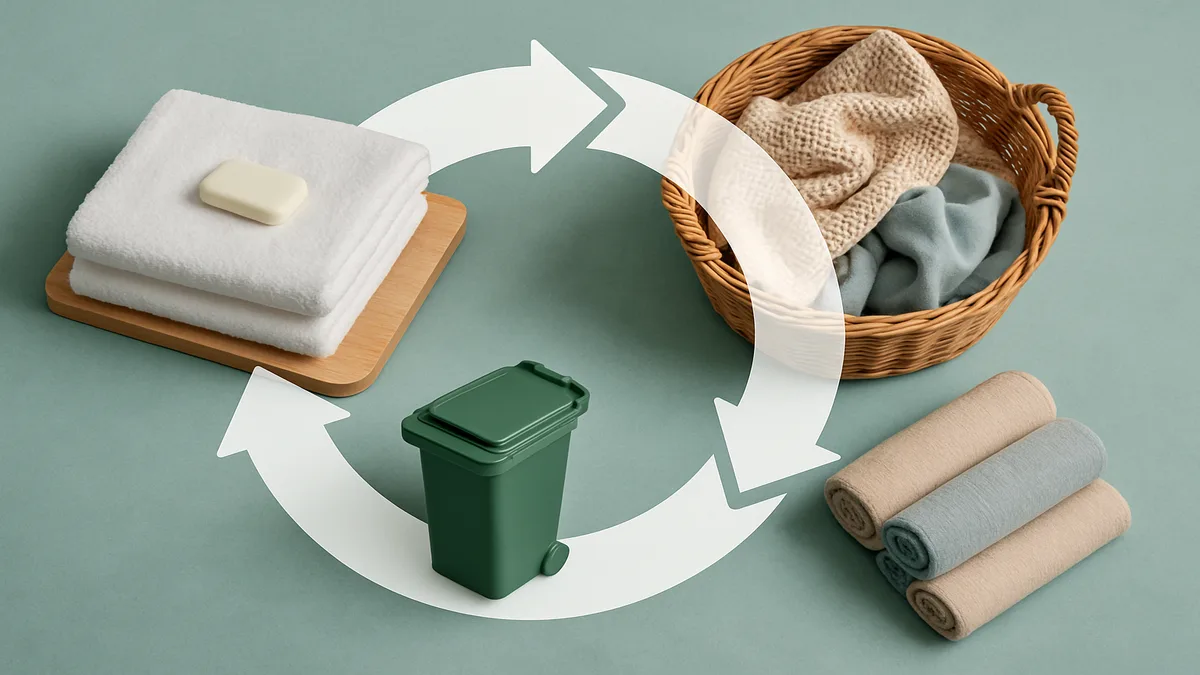
The circular economy flips the traditional linear model (make, use, dispose) into a closed loop (make, use, recover, remake). For hotel suppliers, this means designing products that last longer, offering take-back programs that recover used goods, and selling recycled-content products that close the material loop. Done right, circular programs do not just win sustainability points. They generate recurring revenue, deepen customer lock-in, and create competitive advantages that low-cost competitors cannot replicate.
The timing is favorable — the broader sustainable hotel supply market is on track to exceed $50 billion, and sustainability certifications in hospitality grew 20% between 2022 and 2023. Some 73% of tourists prefer hotels with sustainable practices according to UNWTO data. Marriott has committed to net-zero value chain emissions by 2050 with SBTi verification. Hilton targets a 75% reduction in carbon emissions intensity by 2030. These are not aspirational statements buried in annual reports — they are quantified commitments that will reshape procurement decisions for the next decade.
Circular Economy Principles Applied to Hospitality
The circular economy rests on three core principles: eliminate waste by design, keep products and materials in use, and regenerate natural systems. Here is how each principle maps to the hotel supply chain.
Principle 1: Design for Longevity and Disassembly
Products designed for hotels should be built to last — and built to come apart. A mattress with a modular construction (replaceable comfort layer, separate spring unit, removable cover) can be partially refurbished instead of fully replaced. A desk chair with bolt-on components can have worn seats swapped while the frame serves another decade.
Design strategies for circular hotel products:
- Modular construction. Separate components that wear at different rates. A sofa with replaceable cushion inserts and reupholsterable frames.
- Mono-material design. Products made from a single material type are far easier to recycle. A 100% polyester curtain can be recycled into new polyester fiber. A poly-cotton blend usually cannot.
- Standardized fasteners. Screws instead of glue. Bolts instead of welds where possible. This makes disassembly economically viable.
- Durable finishes. Powder coating over paint. Solution-dyed fiber over piece-dyed. Products that maintain appearance longer reduce replacement frequency.
Principle 2: Keep Products and Materials in Use
This is where take-back programs, refurbishment services, and resale channels come in. The goal is to extract maximum value from every product before it reaches end-of-life — and then recover the materials when it does.
Principle 3: Regenerate Natural Systems
Source materials from regenerative systems: organic cotton grown with soil-building practices, FSC-certified timber from managed forests, recycled metals that reduce mining demand. This is increasingly a procurement requirement, not just a marketing preference.
Five Circular Programs Hotel Suppliers Can Offer
1. Linen and Towel Take-Back Programs
Hotel textiles are one of the highest-volume, most frequently replaced product categories. The hotel textile market was valued at $22.43 billion in 2023 and is projected to reach $53.5 billion by 2032, growing at 10.5% CAGR. Much of that growth is replacement volume — towels and sheets that have reached end-of-life and need to be swapped.
How it works:
- Supplier delivers new linens on a regular schedule (monthly or quarterly)
- At each delivery, supplier collects worn-out inventory
- Collected textiles are sorted: items still serviceable go to secondary markets (shelters, disaster relief, industrial rags); fiber is shredded and recycled into insulation, padding, or new blended yarns
- Hotel receives a credit (typically 5-10% of new order value) for returned goods, incentivizing participation
Why hotels buy in:
- Eliminates disposal logistics and cost
- Supports sustainability certifications (Green Key, EarthCheck, LEED)
- Provides documented diversion-from-landfill metrics for ESG reporting
- Simplifies inventory management — one vendor handles both supply and disposal
Why it locks in business:
Once a hotel integrates your take-back schedule into their operations, switching to a competitor means rebuilding the entire collection and disposal workflow. This is a structural switching cost that no price discount can easily overcome.
2. Furniture Refurbishment Services
Guest room furniture represents one of the largest capital expenditures in a hotel renovation. Room renovations cost $8,000 to $25,000 per room, and casegoods (dressers, desks, nightstands, headboards) account for a significant share. But most hotel furniture is replaced entirely during PIPs — even when the structural components are sound.
A refurbishment program offers:
- On-site assessment of existing furniture condition
- Refinishing of wood surfaces (stripping, restaining, resealing)
- Reupholstering of soft goods (chairs, headboards, bench seats)
- Hardware replacement (drawer pulls, hinges, locks)
- Delivery of refurbished pieces alongside new items for a cohesive look
Economics:
Refurbishment typically costs 40-60% of new replacement. For a 200-room hotel spending $4,500 per room on casegoods, that is a potential savings of $360,000 to $540,000 on the furniture line item alone. Hotels under PIP pressure with tight budgets — and PIPs are currently backlogged at an estimated $12-15 billion industry-wide — find this compelling.
For the supplier, refurbishment creates a second revenue stream from the same customer. You sold them the original furniture. Now you sell them the refurbishment. Later, you sell them the eventual replacement. Three revenue events from one product lifecycle.
3. Mattress Recovery and Recycling
Mattresses are notoriously difficult to dispose of and increasingly regulated. A standard hotel mattress weighs 50-80 pounds and takes up significant landfill space. Several U.S. states now have mattress recycling laws (California, Connecticut, Rhode Island, Oregon), and the EU is tightening mattress disposal regulations.
Program structure:
- Supplier provides new mattresses with a guaranteed take-back at end-of-life (typically 7-10 years)
- At replacement, supplier removes old mattresses and transports to a recycling facility
- Components are separated: steel springs (recycled as scrap metal), foam (shredded for carpet padding or rebonded foam), fabric (recycled as textile fiber or industrial wipe material)
- Hotel receives documentation of recycling rates and diverted tonnage for ESG reporting
This program works especially well when paired with a mattress-as-a-service model, where the hotel pays a monthly per-room fee that covers the mattress, scheduled rotation/flipping, and end-of-life recycling. The supplier retains ownership; the hotel gets a perpetual service.
Stop chasing hotels manually. InnLead.ai’s 12 AI agents scan renovation signals, identify procurement contacts, and book meetings with hotel buyers — automatically. Get Early Access
4. Amenity Packaging Return and Refill Schemes
The regulatory environment is forcing this transition whether suppliers want it or not. As our region-by-region plastic ban guide details, California AB 1162 banned hotels with 50+ rooms from providing personal care products in small plastic containers starting January 2023, extending to all hotels by January 2024. The EU will ban individually packaged hotel amenities (mini shampoos, soaps, condiment packets) in 2026. Scotland and England implemented single-use plastic bans in 2022 and 2023 respectively.
Circular amenity models:
| Model | How It Works | Supplier Revenue |
|---|---|---|
| Bulk dispenser lease | Supplier installs and maintains wall-mounted dispensers; hotel pays monthly per-room fee; supplier refills and services | Recurring monthly revenue per room |
| Refillable branded containers | Supplier provides premium reusable containers; hotel purchases bulk refill product; empty containers returned for cleaning and refilling | Product revenue + container deposit system |
| Concentrated refill program | Supplier provides dilution stations; hotel receives concentrated product and dilutes on-site; reduces shipping volume by 80%+ | Ongoing consumable sales with reduced logistics cost |
The shift from single-use to refillable is not a threat to amenity suppliers — it is a business model upgrade. As we break down in our analysis of refillable dispensers versus single-use economics, single-use amenities are a one-time sale. Refillable systems create monthly recurring revenue with high switching costs (the dispensers are mounted to the wall with your branding).
5. Recycled-Content Product Lines
Hotels are increasingly specifying minimum recycled content in their procurement requirements. This is driven by brand-level sustainability targets and by guest expectations — the 73% preference rate for sustainable hotels cited by UNWTO data translates into real booking behavior that hotel brands track closely.
Product categories with strong recycled-content potential:
- Carpeting and rugs: Post-consumer PET (recycled plastic bottles) woven into carpet fiber. Some manufacturers achieve 100% recycled content.
- Bathroom textiles: Towels from recycled cotton or recycled polyester blends. Slightly higher cost, but growing demand.
- Stationery and paper goods: 100% post-consumer recycled paper for in-room directories, tent cards, notepads.
- Furniture panels: Medium-density fiberboard from reclaimed wood waste. Particleboard from post-industrial sawmill residue.
- Amenity containers: Recycled HDPE or ocean-bound plastic containers.
Pricing premium reality:
Recycled-content products typically carry a 10-25% price premium over virgin-material equivalents. But hotels pursuing LEED certification (over 1,000 hotels globally certified, with rapid growth) or brand sustainability goals will pay the premium because it directly supports their documented targets.
The Circular Economy Model for Hotel Suppliers
The following describes the flow of a circular hotel supply system. It is a loop, not a line.
Stage 1: Sourcing — Raw materials include recycled content (post-consumer fiber, reclaimed wood, recycled metals) and sustainably certified virgin materials (FSC timber, organic cotton, responsibly sourced down).
Stage 2: Manufacturing — Products designed for modularity, durability, and eventual disassembly. Production waste is minimized and recycled back into the process.
Stage 3: Distribution — Reusable packaging (returnable crates, pallet wraps collected on backhaul). Consolidated shipments to reduce transport emissions.
Stage 4: Hotel Use — Products perform their function in guest rooms, lobbies, restaurants, and back-of-house operations. Maintenance and repair services extend useful life.
Stage 5: Recovery — Take-back programs collect end-of-life products. Sorting determines next destination: refurbishment for continued use, component harvesting for spare parts, or material recycling for new products.
Stage 6: Reprocessing — Collected materials are processed back into raw inputs. Recycled fiber becomes new textile. Recovered steel becomes new springs. Reclaimed wood becomes new paneling.
Stage 7: Return to Stage 1. The loop closes.
Each stage represents a potential revenue or cost-saving touchpoint for the supplier. Traditional linear suppliers only participate in Stages 1-3. Circular suppliers participate in all seven — and generate revenue at each one.
Lessons from Other Industries
The hospitality industry is not inventing the circular economy. It is adopting models proven elsewhere.
Automotive: Michelin’s tire-as-a-service model charges fleet operators per kilometer driven rather than per tire purchased. Michelin retains ownership, manages tire maintenance, and recycles at end-of-life. Hotel mattress-as-a-service follows the same logic.
Office furniture: Interface and Steelcase have operated furniture take-back and refurbishment programs for over a decade. Interface’s carpet tile take-back program has recycled billions of pounds of material. Hotel casegoods refurbishment programs are a direct adaptation.
Consumer electronics: Apple’s trade-in program recovers materials from old devices and feeds them back into new product manufacturing. The amenity container return-and-refill model follows the same closed-loop approach.
Fashion/textiles: Patagonia’s Worn Wear program resells used garments and recycles those beyond repair. Hotel linen take-back programs apply identical sorting and secondary-market logic.
How to Launch a Circular Program
Start with one product category. Do not try to make your entire catalog circular at once. Pick the category with the highest replacement frequency and easiest recovery logistics — typically linens or amenities.
Partner with recyclers before you launch. You need downstream processing capacity committed before you start collecting. A take-back program without a recycling partner is just a warehouse full of used towels.
Build the cost model honestly. Collection, sorting, transportation, and processing all cost money. The revenue comes from reduced customer acquisition cost (take-back creates lock-in), premium pricing on recycled-content products, and secondary material revenue. Model all three before you set pricing.
Document everything. Hotels need metrics for ESG reporting: tons diverted from landfill, percentage of recycled content, carbon offset equivalents. If you cannot provide a quarterly sustainability report to your customers, your circular program is a nice idea but not a competitive advantage.
Get certified. Cradle to Cradle certification, Global Recycled Standard (GRS), OEKO-TEX, and Blue Angel are all recognized in hospitality procurement. Third-party certification transforms a marketing claim into a procurement specification.
The Business Case in Numbers
For a supplier serving 50 hotel properties with a combined 10,000 rooms:
| Revenue Stream | Annual Value |
|---|---|
| Product sales (linens, amenities, furniture) | $2.4M (base business) |
| Take-back credit offset (reduces new product discount pressure) | $120K retained margin |
| Refurbishment services | $340K (renovation cycle years) |
| Recycled material resale | $85K |
| Amenity refill recurring revenue | $480K |
| Sustainability documentation and reporting | $60K |
| Total circular economy revenue uplift | $1.085M (45% above base) |
These are not theoretical numbers. They are based on program economics from suppliers operating circular models in adjacent industries, scaled to hospitality volumes. The exact figures will vary by product category and customer mix, but the magnitude is directional.
The circular economy is not charity. It is not compliance. It is a business model that generates more revenue per customer, creates deeper switching costs, and positions suppliers ahead of regulatory requirements that are coming whether the industry is ready or not. The EU amenity ban in 2026 is just the beginning.
Suppliers who build circular capabilities now will own the sustainability conversation with hotel buyers for the next decade. The $12-15 billion hotel renovation wave makes this the ideal moment to introduce circular programs alongside new product specifications. Suppliers who wait will find themselves scrambling to catch up — or losing business to competitors who already have take-back trucks on the road. Ready to connect with hotels actively investing in sustainable procurement? Contact InnLead.ai to learn how.
Use these related guides to keep moving through the same procurement, sales, or market research thread.
Skip the Manual Work
InnLead.ai's 12 AI agents find hotels buying your products, identify procurement contacts, and book meetings -- automatically.
Get Early Access