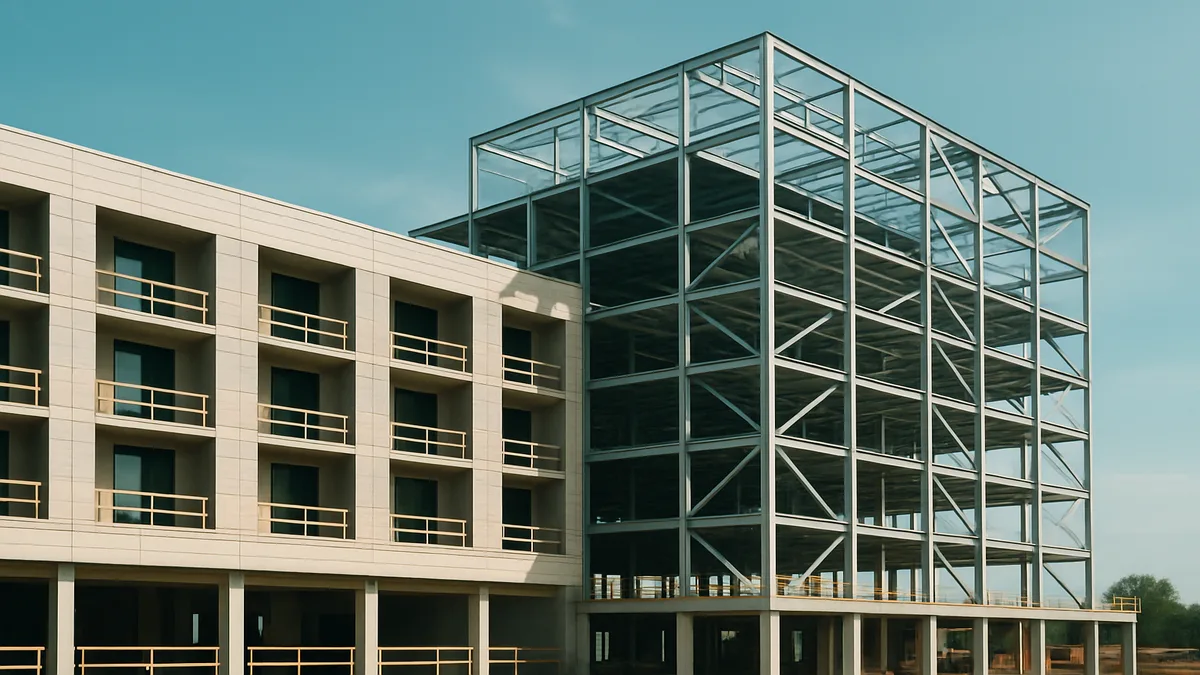
The global hotel construction pipeline reached an all-time record at the close of Q4 2024: 15,820 projects representing 2,438,189 rooms. That is a 4% increase in projects and 3% increase in rooms year-over-year. Every one of those projects will need furniture, fixtures, equipment, linens, technology, amenities, and operating supplies. For hotel suppliers, this pipeline is not just a statistic — it is a customer acquisition map.
This report breaks down the pipeline by region, by brand, and by hotel segment, then shows suppliers exactly how to position for pre-opening procurement — the highest-value, highest-volume sales opportunity in the hotel supply chain.
Global Pipeline Overview
The hotel construction pipeline has been setting records consistently since 2023. Here is the trajectory:
| Period | Projects | Rooms | Year-Over-Year Change |
|---|---|---|---|
| Q4 2023 | 15,196 | 2,370,000 | +7% projects, +3% rooms |
| Q4 2024 | 15,820 | 2,438,189 | +4% projects, +3% rooms |
New hotel openings are also accelerating:
- 2023 openings: 2,658 hotels / 416,640 rooms
- 2024 openings: 2,786 hotels / 435,870 rooms (forecast)
- 2024 actual: 2,226 hotels opened (7% increase YoY in completions)
The gap between pipeline projects and actual openings reflects typical development timelines of 24-48 months from groundbreaking to opening. Projects entering the pipeline today will be placing procurement orders in 2025-2027 — which is the window suppliers should be targeting.
Pipeline by Region
United States: The World’s Largest Pipeline
The U.S. hotel construction pipeline reached an all-time high of 6,378 projects as of Q4 2024, up from the previous record of 5,964 projects at the end of 2023. The U.S. accounts for roughly 40% of all global hotel projects.
Key U.S. market highlights:
- Dallas and Atlanta led all global markets in pipeline volume
- The Sun Belt continues to dominate: Texas, Florida, Georgia, and the Carolinas account for disproportionate share
- RevPAR growth of approximately 3% in 2024 underpins developer confidence
- Hotel tech budgets are shifting rapidly: 69% of budget now allocated to new software (up from 23% in 2022)
What U.S. pipeline hotels need:
The overwhelming majority of U.S. pipeline projects are select-service and extended-stay properties in the midscale to upper-midscale segments. These hotels need standardized FF&E packages, case goods, soft goods, bathroom fixtures, lighting, and technology. Procurement is typically managed by the brand (through approved vendor lists) or by the ownership group’s purchasing company.
Middle East: The Boom Market
The Middle East hotel pipeline hit an all-time record: 659 projects / 163,816 rooms, an 8% increase year-over-year. This is the fastest-growing hotel construction region in the world, driven by Saudi Vision 2030, Dubai’s continued expansion, and Abu Dhabi’s tourism diversification.
Saudi Arabia is the engine: 349 projects / 94,287 rooms as of Q3 2025 — an all-time high, up 10% in projects and 18% in rooms year-over-year. Our Saudi Arabia Vision 2030 supplier guide covers the mega-project pipeline, procurement processes, and local content requirements in full. The UAE has 136 new hotels in its pipeline, with Dubai alone accounting for 87 hotel debuts.
Middle East pipeline by segment:
| Segment | Projects | Rooms | Share of Pipeline |
|---|---|---|---|
| Luxury | 199 | 44,059 | 27% of rooms |
| Upscale | 166 | 47,974 | 29% of rooms |
| Upper Midscale and below | 294 | 71,783 | 44% of rooms |
Luxury and upscale properties account for 55% of the Middle East pipeline. This is critical for suppliers because luxury and upscale hotels spend 3-5x more per room on FF&E and OS&E than midscale properties. A 300-room luxury hotel in Riyadh represents a procurement budget of $5-15 million for a single property.
What Middle East hotels need:
- Custom-designed FF&E that meets luxury brand standards and local cultural preferences
- Heat-resistant and UV-stable materials for exterior furnishings and pool areas
- Sustainability-compliant products (LEED, Estidama, BREEAM certifications are common requirements)
- High-end bathroom fixtures, amenities, and technology packages
- Regional sourcing is preferred but not always available — European and North American suppliers have significant opportunity
Asia Pacific (Excluding China): Record Development
Asia Pacific (ex-China) reached a record 1,977 projects / 402,156 rooms at the end of 2023, with strong sustained activity into 2024 and 2025.
Top Asia Pacific markets:
| Country | Projects | Rooms | Notable |
|---|---|---|---|
| India | 514 | 61,075 | 26% of regional pipeline |
| Vietnam | 253 | 88,827 | Highest rooms per project (large resort developments) |
| Indonesia | 208 | — | Strong domestic tourism demand |
| Thailand | 155 | — | Luxury and resort segment leading |
| Japan | 155 | — | Inbound tourism recovery post-COVID |
2025 forecast: 379 hotels / 76,422 rooms opening across the region.
India is the standout. With 514 projects representing over a quarter of the regional pipeline, India’s hotel construction is accelerating across all segments. Our Asia-Pacific hotel supply market entry guide covers country-by-country strategies for capturing this growth. Marriott, Hilton, IHG, and Accor are all expanding aggressively in Indian markets.
Luxury development is surging: luxury projects grew 9% year-over-year to 241 projects, and upper upscale grew 12% to 370 projects. This signals sustained demand for high-specification FF&E and premium OS&E.
China: Second-Largest Pipeline Globally
China’s hotel construction pipeline reached an all-time high of 3,788 projects / 691,772 rooms at the end of Q4 2023, making it the second-largest pipeline globally behind only the United States.
The Chinese market is primarily served by domestic manufacturers, but international suppliers have opportunities in:
- International luxury brands opening in tier-1 cities (Four Seasons, Aman, Rosewood)
- Western brand standards that require imported specifications
- Technology and smart room systems where Western suppliers have quality advantages
Europe: Steady Pipeline, Surging Conversions
Europe’s pipeline is stable but evolving. Total projects at Q4 2024: 1,661 projects / 244,464 rooms. The headline story is not new construction — it is conversions.
Europe conversions surged 26% in Q4 2024: 520 projects / 61,550 rooms. This means existing hotels are being rebranded and renovated to new brand standards — which requires full FF&E replacement to meet the new brand’s design specifications.
European pipeline details:
| Metric | Q4 2023 | Q4 2024 | Change |
|---|---|---|---|
| Total projects | 1,706 | 1,661 | -3% |
| Total rooms | 254,937 | 244,464 | -4% |
| Luxury projects | ~130 | 139 | Near all-time high |
| Upper upscale projects | ~275 | 284 | +3% |
| Conversion projects | ~413 | 520 | +26% |
2024 forecast: 356 hotel openings / 48,888 rooms. 2025 forecast: 406 hotel openings / 56,127 rooms.
The conversion surge is particularly important for suppliers. As our analysis of the 2026 hotel renovation boom and FF&E opportunity details, a brand conversion typically requires more extensive FF&E replacement than a standard renovation because the incoming brand’s design package differs entirely from the outgoing brand. Where a PIP renovation might replace 40-60% of room furnishings, a brand conversion often replaces 80-100%.
Stop chasing hotels manually. InnLead.ai’s 12 AI agents scan renovation signals, identify procurement contacts, and book meetings with hotel buyers — automatically. Get Early Access
Pipeline by Brand: Who Is Building the Most
The major hotel companies are driving the pipeline through aggressive development agreements. Here are the key brand-level numbers suppliers should track.
Marriott International
- Signed 1,200+ deals in 2024 representing 162,000 rooms
- Total pipeline: 596,000 rooms
- Added 120,000+ rooms globally in 2024
- Launched Four Points Flex by Sheraton (2023) — conversion brand targeting 50+ hotels by 2026
- Acquired City Express midscale brand (late 2022) with expansion to U.S./Canada franchisees
Marriott’s pipeline is the largest of any hotel company. Their approved vendor list (AVL) is the most valuable credential a hotel supplier can hold. Suppliers on the Marriott AVL have access to a purchasing network that serves 8,000+ properties.
Hilton Worldwide
- System reached 8,397 hotels / 1,251,068 rooms in 2024
- Launched Spark by Hilton (2023) — premium economy conversion brand; surpassed 100 hotels by 2024
- Partnership with Small Luxury Hotels of the World (SLH) — approximately 450 independent luxury properties added
- Connected Room technology expanding annually
Spark by Hilton is a conversion brand, meaning every Spark opening is a renovation project requiring FF&E and OS&E to be replaced to meet Hilton’s design standards. At 100+ properties and growing, this is a significant procurement wave.
IHG Hotels & Resorts
- 2024: Opened 59,100 rooms across 371 hotels; signed 106,200 rooms across 714 hotels (34% increase)
- Doubled German footprint via Novum Hospitality deal (April 2024)
- Launched Garner midscale conversion brand (August 2023) — targeting 500 hotels in 10 years, 1,000 in 20 years in the U.S. alone
- Noted Collection launched February 2026 — premium/luxury lifestyle brand
IHG’s Garner brand alone represents a potential 500-property procurement pipeline over the next decade. Each Garner conversion requires a full FF&E refresh to meet brand standards.
Accor
- 58% of 2024 openings under lifestyle brands (Emblems, MGallery, Mondrian, Handwritten Collection, Mercure, TRIBE)
- Pipeline: 1,381 hotels / 233,000 rooms in 2025
- Orient Express brand relaunch with LVMH (June 2024)
Accor’s heavy skew toward lifestyle brands means more design-forward, less standardized FF&E — which favors specialized suppliers who can deliver custom or semi-custom products.
Hyatt Hotels
- Record pipeline of 127,000 rooms (year-end 2023)
- Acquired Dream Hotels Group (Nov 2022), Mr and Mrs Smith (April 2023), Standard International (late 2023), and me and all hotels (June 2024)
- Growth strategy focused on lifestyle and luxury through acquisitions
Hyatt’s acquisition strategy means dozens of acquired properties will undergo renovation to align with Hyatt brand standards — creating procurement opportunities.
How to Target Pre-Opening Procurement
New hotel openings represent the single largest procurement event in a property’s lifecycle. A new 200-room select-service hotel will spend $2-5 million on FF&E and OS&E before it welcomes its first guest. A luxury property might spend $10-20 million. Here is how to position for that spend.
Understanding the Procurement Timeline
| Phase | Timing (Before Opening) | Key Activities |
|---|---|---|
| Planning/Design | 24-36 months | Brand standards finalized; design firm selected; conceptual designs approved |
| Specification | 18-24 months | Specific products selected; FF&E specifications written; mockup rooms built |
| Bidding/Purchasing | 12-18 months | RFPs issued to approved vendors; bids evaluated; purchase orders placed |
| Manufacturing | 8-14 months | Products manufactured to specification; quality inspections; staging |
| Delivery/Installation | 2-6 months | Phased delivery to site; installation; punch list; final inspection |
The critical window is 18-24 months before opening, when specifications are being written and vendor selections are being made. By the time RFPs go out at 12-18 months, the shortlist is often already set. Suppliers who engage at the specification stage have a structural advantage.
Where to Find Pipeline Intelligence
- Lodging Econometrics publishes quarterly pipeline reports with project-level detail (property name, location, brand, room count, expected opening date)
- STR (CoStar) tracks global hotel pipeline data with market-level granularity
- Smith Travel Research provides construction pipeline analytics
- Brand development websites (Marriott Development, Hilton Development, IHG Development) list open franchising opportunities and recently signed deals
- Local building permit databases capture projects before they appear in national databases
Who to Contact
For branded properties:
- Brand VP of Design — influences which suppliers get specified
- Brand Procurement Director — manages the approved vendor list
- Owner’s Representative — the individual hired by the hotel owner to manage the development project
- Purchasing Agent/FF&E Procurement Company — firms like Wayfind, Procurement Resources, or The Parker Company that manage FF&E purchasing for owners
For independent properties:
- Hotel Owner/Developer — direct decision maker
- Interior Design Firm — specifies products; their recommendation carries enormous weight
- General Contractor — sometimes manages FF&E procurement, especially for smaller projects
How to Win Pre-Opening Business
-
Get on approved vendor lists early. For brands, this means applying to their vendor qualification program well before a specific project. Marriott, Hilton, and IHG all have formal AVL processes with documentation requirements (insurance, certifications, references, product testing).
-
Build relationships with design firms. Firms like Stonehill Taylor, Wilson Associates, HBA, and Gettys Group specify millions of dollars in FF&E annually. If a designer specifies your product, the procurement company usually purchases it.
-
Offer mockup room support. Every new hotel builds one or more mockup rooms before committing to full-property purchases. Suppliers who provide products for mockup rooms at reduced or no cost gain a massive advantage — the brand team physically experiences your product during the approval process.
-
Provide specification-ready documentation. CAD files, material specifications, fire-test certifications, sustainability certifications, lead times, and pricing — all formatted to drop directly into the design specification book. Make it easy for the designer to choose you.
-
Target conversion brands specifically. Hilton’s Spark (100+ properties), IHG’s Garner (targeting 500+), and Marriott’s Four Points Flex are all conversion brands. Every conversion is a renovation project that needs new FF&E. These brands have the most concentrated procurement activity in the industry right now.
Regional Pipeline Summary Table
| Region | Projects (Latest) | Rooms | YoY Trend | Key Driver |
|---|---|---|---|---|
| United States | 6,378 | — | All-time high | Select-service, extended-stay |
| Middle East | 659 | 163,816 | +8% | Saudi Vision 2030, luxury development |
| Asia Pacific (ex-China) | 1,977 | 402,156 | Record high | India (26% of pipeline), Vietnam resort development |
| China | 3,788 | 691,772 | All-time high | Domestic brand expansion |
| Europe | 1,661 | 244,464 | Stable (-3%) | Conversions surging +26% |
| Global Total | 15,820 | 2,438,189 | +4% | Record across all metrics |
What This Means for Suppliers
The construction pipeline tells you where the money will be spent. The brand expansion data tells you who will spend it. The segment breakdown tells you what price point and quality level they need.
Suppliers who map their product catalog to these specific pipeline concentrations — midscale select-service in the U.S. Sun Belt, luxury in the Middle East, lifestyle conversions in Europe, economy and midscale in India — will capture a disproportionate share of pre-opening procurement.
The pipeline data also reveals timing. Projects currently in the planning phase (24-36 months from opening) will enter their procurement window in 2026-2027. The time to begin relationship-building with brand development teams, design firms, and purchasing agents is now — not when the RFP lands in your inbox alongside 15 other vendors.
A record 15,820 projects means a record number of procurement decisions. The question is whether your business is positioned to be part of those decisions. Understand what hotels spend on furniture, fixtures, and equipment per room and how the $12-15 billion PIP renovation backlog creates additional procurement demand beyond new construction. See how InnLead.ai tracks pipeline signals and identifies procurement contacts to help you reach buyers before competitors do.
Use these related guides to keep moving through the same procurement, sales, or market research thread.
Skip the Manual Work
InnLead.ai's 12 AI agents find hotels buying your products, identify procurement contacts, and book meetings -- automatically.
Get Early Access