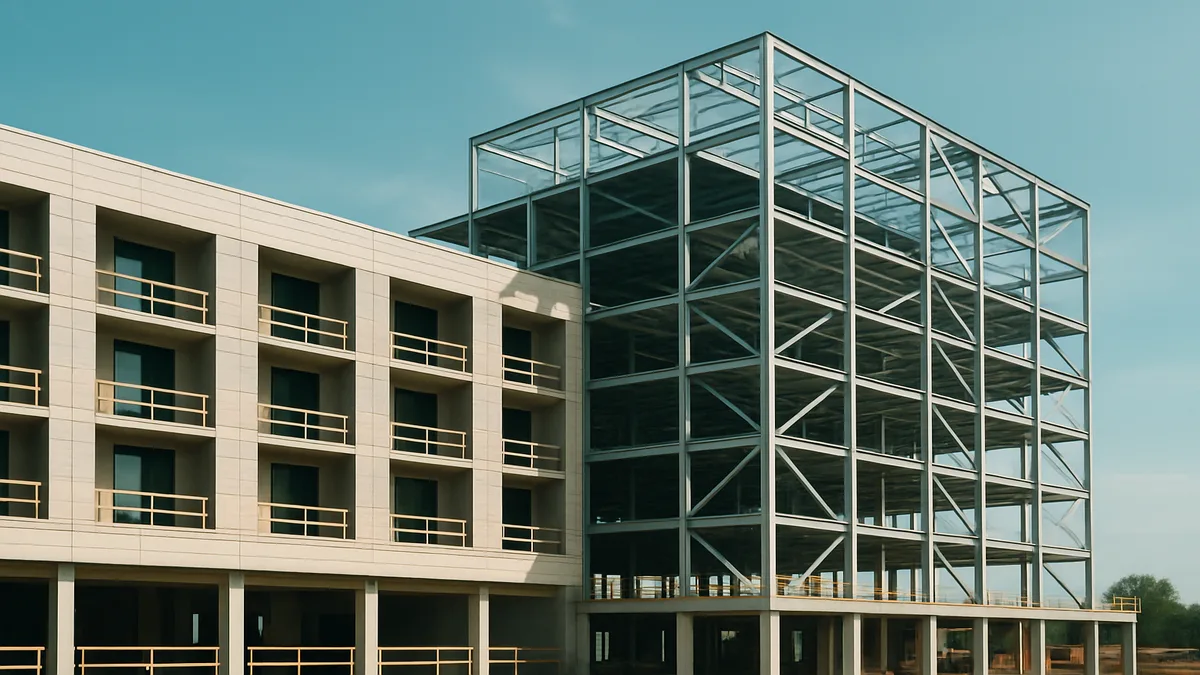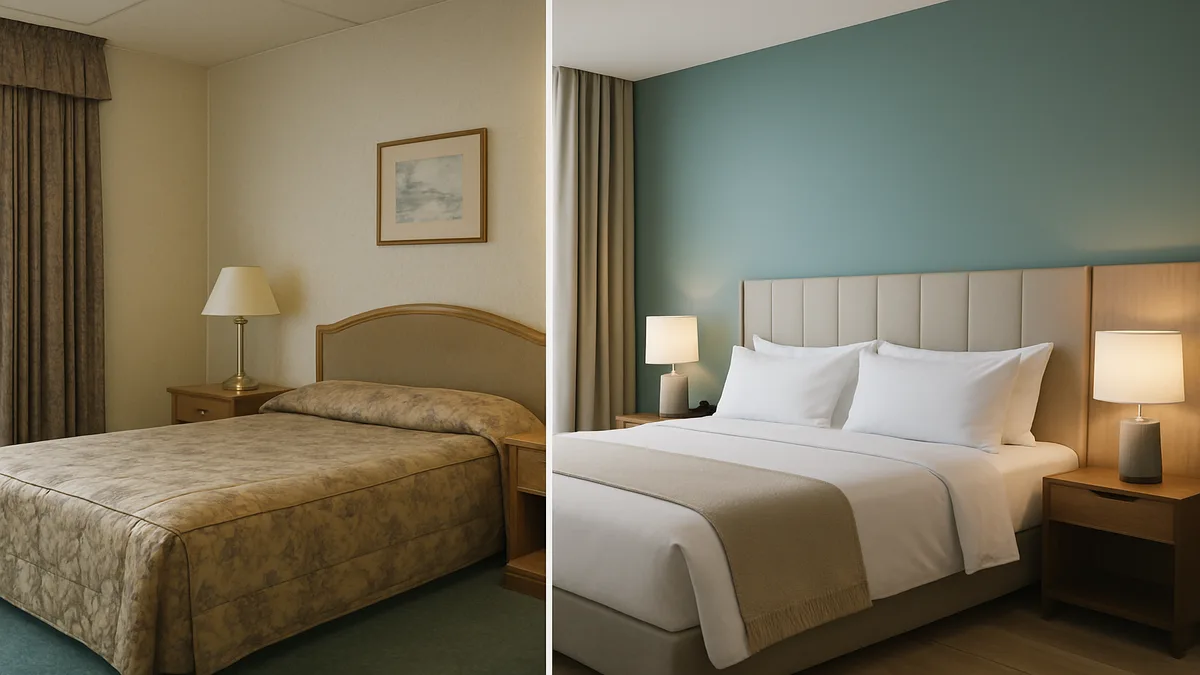
The hotel industry is in the middle of the largest renovation cycle in more than a decade. The numbers are staggering: an estimated $12-15 billion in deferred Property Improvement Plans (PIPs) are now executing. Brand conversions are at record pace. Guest room renovation costs have surged to $8,000-$25,000 per room. And the hotel FF&E market, valued at approximately $55-59 billion in 2023, is on track to reach $107 billion by 2030 at a CAGR of 6.9-7.3%.
For FF&E and OS&E suppliers, 2026 is not just a good year. It is a generational opportunity. As our hotel supply industry report documents, the combined FF&E, linen, amenities, and textile market stands at $137-142 billion and is projected to double within a decade. The convergence of deferred maintenance, brand standard upgrades, new conversion brand pipelines, and post-pandemic design overhauls is creating a procurement wave that will define supplier revenue trajectories for the next five years. This report quantifies the opportunity, maps the hotspots, and provides a detailed playbook for suppliers who want to capture their share.
Why 2026 Is the Peak of the Renovation Cycle
The PIP Backlog Finally Breaks
Property Improvement Plans are the contractual obligations that require franchise hotel owners to renovate their properties to meet evolving brand standards. PIPs typically run on 5-7 year cycles. The COVID-19 pandemic disrupted this cycle catastrophically.
Between 2020 and 2022, hotel owners negotiated PIP deferrals and extensions with their brand companies. Occupancy had collapsed. Capital was scarce. Brands granted temporary relief because the alternative — terminating franchise agreements with struggling owners — would have shrunk their own systems.
By 2023, those deferrals were expiring. Brands began enforcing PIP compliance again, but the backlog was enormous — $12-15 billion in outstanding renovation work industry-wide. Renovation costs had also escalated dramatically: PIP costs increased 30%+ versus pre-COVID levels, and hospitality vendors reported price hikes of 90-300% on various products.
In 2024, the dam began to break. Renovation activity surged, conversion projects hit record numbers, and suppliers who had capacity to deliver saw order books fill. Our detailed breakdown of how PIPs work and the $12-15 billion backlog explains the mechanics behind this wave. In 2026, the cycle is at or near its peak. The deferred PIPs from 2020-2022 are three to six years overdue. Brand companies are no longer granting extensions. Owners must renovate or face termination.
Renovation Cost Escalation
The economics of hotel renovation have changed fundamentally since 2019.
| Cost Factor | Pre-COVID (2019) | 2023-2024 | Change |
|---|---|---|---|
| PIP costs (index) | 100 | 130+ | +30%+ |
| Renovation cost increase (2022-2023) | — | +6.25% | Annual escalation |
| Timber prices (2022 vs. 2024) | — | +35% | Structural material cost driver |
| Guest room renovation cost | $6,000-$18,000/room | $8,000-$25,000/room | +33-39% range increase |
| Vendor price hikes (reported) | Baseline | 90-300% on various products | Dramatic post-pandemic inflation |
These higher costs mean higher-value purchase orders for suppliers on every project. A 200-room midscale PIP renovation that would have generated $1.2 million in FF&E orders in 2019 now generates $1.6-2.0 million. For luxury properties, the numbers are significantly larger.
Brand Conversions Accelerate
Brand conversions — where an existing hotel leaves one brand and joins another, or where an independent hotel affiliates with a brand for the first time — are running at record pace. This matters for suppliers because every conversion requires a full or near-full FF&E replacement to meet the new brand’s design standards.
Conversion brands driving the pipeline:
| Brand | Parent Company | Launched | Pipeline Status | FF&E Impact |
|---|---|---|---|---|
| Spark by Hilton | Hilton | 2023 | Surpassed 100 hotels by 2024 | Full FF&E refresh per brand standards |
| Garner | IHG | August 2023 | Targeting 500 hotels in 10 years; 1,000 in 20 years (U.S.) | Complete renovation to IHG midscale standards |
| Four Points Flex by Sheraton | Marriott | 2023 | Targeting 50+ hotels by 2026 | Conversion-specific FF&E package |
| Noted Collection | IHG | February 2026 | New premium/luxury lifestyle | High-specification FF&E for luxury conversion |
| Vignette Collection | IHG | Active | Targeting 100+ properties over a decade | Upscale/luxury conversion package |
| HQ Hotels & Residences | Wyndham/SBE | Announced | Lifestyle brand entering pipeline | Design-forward FF&E required |
Europe alone saw conversions surge 26% in Q4 2024: 520 projects representing 61,550 rooms. Conversion activity in the U.S. is even higher in absolute terms, driven by the new midscale conversion brands from Hilton, IHG, and Marriott that specifically target existing hotels for rebranding.
A standard PIP renovation might replace 40-60% of room furnishings. A full brand conversion typically replaces 80-100% because the incoming brand’s design package — furniture styles, color palettes, fixture specifications, signage, and technology — differs entirely from what is currently installed.
Which Brands Are Renovating the Most
Marriott International
Marriott’s scale makes it the largest single source of renovation procurement in the industry. The company signed 1,200+ deals in 2024 representing 162,000 rooms, and its total pipeline stands at 596,000 rooms. With over 8,000 existing properties, the ongoing PIP cycle alone generates billions in annual renovation spending.
Key Marriott renovation drivers:
- Four Points Flex conversions requiring standardized FF&E packages
- Ongoing PIP compliance across Courtyard, Fairfield, and Residence Inn portfolios (the highest-volume brands)
- City Express brand integration following the late 2022 acquisition — “Project Mid-T” expansion requires property upgrades
- Brand standard evolution driving soft goods refreshes (linens, curtains, decorative pillows) on shorter cycles than hard goods
For suppliers, Marriott’s Approved Vendor List (AVL) remains the most valuable single credential in hotel procurement. Approval requires product testing, insurance documentation, references, and typically 6-18 months of relationship-building.
Hilton Worldwide
Hilton’s system of 8,397 hotels and 1,251,068 rooms means an enormous base of properties cycling through renovations. Spark by Hilton — which targets existing hotels for conversion to Hilton’s premium economy brand — has surpassed 100 properties in its first 18 months and represents a concentrated wave of renovation procurement.
Key Hilton renovation drivers:
- Spark by Hilton conversions (100+ and accelerating)
- Connected Room technology rollout requiring furniture modifications (power, data integration into casegoods and headboards)
- SLH partnership bringing ~450 independent luxury properties into the Hilton ecosystem, some requiring upgrades to meet Hilton Honors integration standards
- Sustainability-driven product refreshes targeting 50% reduction in landfill waste by 2030
IHG Hotels & Resorts
IHG’s 714 hotel signings in 2024 (a 34% increase) and the Garner brand’s target of 500 hotels in 10 years make IHG one of the most active sources of conversion-driven renovation demand. The Novum Hospitality deal doubled IHG’s German footprint, and those properties will undergo brand standard upgrades.
Key IHG renovation drivers:
- Garner conversions at aggressive pace (targeting one new hotel every week at steady state)
- Novum Hospitality portfolio integration and brand alignment
- Noted Collection launch (February 2026) creating new luxury conversion opportunities
- Vignette Collection scaling toward 100+ properties
Hyatt Hotels
Hyatt’s acquisition strategy — Dream Hotels, Mr and Mrs Smith, Standard International, and me and all hotels — means dozens of properties across multiple brands are being integrated into Hyatt’s system. Each acquisition brings properties that may need renovation to align with Hyatt brand standards or to be repositioned within Hyatt’s portfolio.
Key Hyatt renovation drivers:
- Integration of acquired hotel brands (Standard Hotels, Dream Hotels, me and all hotels)
- Record pipeline of 127,000 rooms requiring pre-opening procurement
- Lifestyle brand positioning requiring design-forward, non-standardized FF&E
Which Segments Are Leading Renovation Activity
Midscale: The Volume Play
Midscale hotels represent the highest volume of renovation activity due to three factors: the largest number of existing properties (more hotels need renovation), the shortest PIP cycles (5-6 years), and the new conversion brands specifically targeting this segment (Spark, Garner, Four Points Flex).
Midscale renovation characteristics:
- Room renovation budget: $8,000-$14,000 per room
- FF&E is highly standardized (brand-dictated design packages with limited customization)
- Procurement is often managed through brand purchasing programs or designated purchasing companies
- Volume per project: 80-150 rooms typical
- Speed is critical: many midscale hotels remain open during renovation, losing revenue on out-of-service rooms
For suppliers, midscale renovation is a volume game. Margins per unit are lower, but order quantities are high, product specifications are standardized (reducing design and engineering costs), and the pipeline of projects is the deepest of any segment.
Upscale: The Margin Opportunity
Upscale hotels — brands like Marriott’s Courtyard, Hilton Garden Inn, Hyatt Place, and IHG’s voco — are renovating at a strong pace, driven by the same PIP backlog and by competitive pressure from newly converted lifestyle brands entering the segment.
Upscale renovation characteristics:
- Room renovation budget: $14,000-$22,000 per room
- Greater design differentiation than midscale; more custom specifications
- Higher-quality materials and finishes (solid wood versus laminate, higher-GSM textiles, premium bath fixtures)
- Procurement may involve interior design firms in addition to brand purchasing
- Volume per project: 120-250 rooms typical
Upscale renovation offers a strong balance of margin and volume. Suppliers who can deliver design-differentiated products at scale — not fully custom, but configurable within a range of options (multiple finishes, fabric choices, hardware options) — are best positioned.
Luxury: The High-Value Niche
Luxury renovations represent the smallest number of projects but the highest value per project. The Middle East luxury pipeline alone includes 199 projects and 44,059 rooms. Europe has 139 luxury projects near an all-time high. Global luxury hotel development is being driven by new brand launches (Accor + LVMH’s Orient Express, IHG’s Noted Collection) and by independent luxury properties affiliating with networks like SLH.
Luxury renovation characteristics:
- Room renovation budget: $22,000-$50,000+ per room (some ultra-luxury projects exceed $80,000)
- Fully custom FF&E designed by named interior design firms (HBA, Wilson Associates, Champalimaud, Yabu Pushelberg)
- Materials include natural stone, custom metalwork, bespoke textiles, handcrafted furniture
- Procurement managed by the design firm and/or specialized luxury FF&E purchasing agents
- Volume per project: 100-400 rooms, but with significantly higher spending per room
For suppliers, luxury renovation requires design capability, sample development speed, and the ability to execute one-of-a-kind specifications at commercial scale. The margins are the highest in the industry, but the sales cycle is longer and the competition is more specialized.
Stop chasing hotels manually. InnLead.ai’s 12 AI agents scan renovation signals, identify procurement contacts, and book meetings with hotel buyers — automatically. Get Early Access
Regional Renovation Hotspots
United States
The U.S. is the epicenter of the renovation boom. With a construction pipeline at an all-time high of 6,378 projects, the new-build activity is supplemented by a massive PIP renovation cycle across the existing 55,000+ branded hotel properties. Dallas and Atlanta led all global markets in development activity. The Sun Belt states (Texas, Florida, Georgia, Carolinas, Arizona) dominate both new construction and renovation spending.
U.S. renovation spending indicators:
- Hotel RevPAR grew approximately 3% in 2024, underpinning owner confidence in renovation ROI
- Technology budgets shifted from 23% on new software (2022) to 69% (2024), meaning renovation scope now includes significant technology upgrades
- The midscale segment is seeing the most concentrated renovation activity due to Spark, Garner, and Four Points Flex conversion activity
Middle East
The Middle East is primarily a new-build market, but renovation activity is growing as the region’s first wave of modern luxury hotels (built 2008-2015) enters its first major renovation cycle. The pipeline of 659 projects and 163,816 rooms also includes significant renovation and repositioning projects.
Saudi Arabia’s 349 projects and 94,287 rooms — explored in depth in our Saudi Arabia Vision 2030 supplier guide — include renovations of existing properties being repositioned for Vision 2030 tourism targets. Hotels built for business travel are being renovated for leisure and cultural tourism — requiring different FF&E, different amenity programs, and different technology packages.
Europe
Europe’s renovation story is driven by conversions. The 26% surge in conversion projects in Q4 2024 (520 projects, 61,550 rooms) means hundreds of European hotels are undergoing full brand transitions requiring complete FF&E replacement.
The 2025 forecast of 406 hotel openings includes a significant share of converted properties. European luxury projects (139 projects, 18,515 rooms) are near an all-time high, and upper upscale projects (284 projects, 46,717 rooms) grew 3% year-over-year. This signals strong renovation and conversion activity at the premium end of the market.
The EU’s 2026 ban on individually packaged hotel amenities is also driving amenity-system renovations across the continent — hotels must install bulk dispenser systems and redesign bathroom countertops and shower enclosures to accommodate them.
Renovation Spending Forecast
Based on pipeline data, PIP backlog estimates, and per-room renovation cost ranges, the following table projects renovation-related FF&E and OS&E spending for 2025-2028.
| Year | Estimated Renovation Projects (Global) | Avg. FF&E Spend Per Room | Estimated Total FF&E Renovation Spend |
|---|---|---|---|
| 2025 | ~2,800 major renovations | $12,500 | $8.4B |
| 2026 | ~3,200 major renovations (peak) | $13,200 | $10.1B |
| 2027 | ~2,900 major renovations | $13,800 | $9.6B |
| 2028 | ~2,500 major renovations (normalization) | $14,400 | $8.6B |
Estimates based on industry PIP backlog data, brand conversion pipelines, per-room cost benchmarks ($8,000-$25,000), and projected cost escalation of 5-6% annually. Includes rooms under renovation; excludes new construction FF&E.
These estimates are conservative. They do not include soft goods refresh cycles (linens, drapery, decorative items) that occur on 3-4 year cycles independent of major PIPs, nor do they include technology upgrades that are increasingly bundled into renovation projects. The total addressable renovation market including all product categories likely exceeds these figures by 30-50%.
How to Position for PIP Procurement
Timing: When to Engage
The procurement timeline for a hotel renovation differs from new construction. Renovations operate on compressed schedules because the hotel is typically open and losing revenue on rooms under construction.
| Phase | Timing (Before Renovation Start) | Supplier Action |
|---|---|---|
| PIP issued by brand | 12-24 months | Monitor brand PIP announcements; identify properties receiving PIPs |
| Owner hires design firm / purchasing agent | 8-18 months | Build relationships with design firms and purchasing companies |
| Design development and specifications | 6-12 months | Provide samples, pricing, and specification documentation |
| Bidding and vendor selection | 4-8 months | Submit bids; offer mockup room support |
| Purchase orders placed | 3-6 months | Execute production; coordinate delivery scheduling |
| Delivery and installation | 0-3 months | Phased delivery to match renovation schedule; installation support |
The critical window is 8-18 months before renovation start, when the design team is selecting products and the purchasing agent is building the vendor shortlist. By the time formal bids go out, the preferred suppliers are often already identified. AI-powered procurement tools can help suppliers detect these windows earlier and engage before the competition.
Contacts: Who Makes the Decision
For branded hotel renovations, the decision-making chain typically includes:
-
Brand Design Team — Sets brand standards and approves design packages. Their specification directly determines which products can be used. Relationship value: highest for long-term positioning.
-
Interior Design Firm — Hired by the owner to develop the room design within brand standards. They select specific products, materials, and finishes. Relationship value: highest for individual project wins.
-
FF&E Purchasing Company — Firms like Wayfind, Procurement Resources, The Parker Company, orDERA that manage the bidding, ordering, and logistics of FF&E procurement. They execute the designer’s specifications and the owner’s budget. Relationship value: high for consistent deal flow.
-
Hotel Owner / Asset Manager — Approves the budget and has final authority on spending. Rarely involved in individual product selection but sets the overall financial parameters.
-
General Contractor — Manages the construction timeline. Coordinates delivery scheduling with the FF&E supplier. Does not select products but controls site access.
Product Specifications: What to Have Ready
Hotels under PIP renovation operate under strict brand design standards. Suppliers need the following documentation ready before engaging:
- Complete product specifications matching brand standard requirements (dimensions, materials, finishes, performance ratings)
- Fire-test certifications (California TB 117-2013, BS 5852, EN 1021-1/2 depending on geography)
- ADA compliance documentation where applicable (minimum 32” clear door width, counters max 36” high, accessible room configurations)
- Sustainability certifications (recycled content, VOC levels, FSC certification, Cradle to Cradle, OEKO-TEX)
- Warranty documentation with clear terms for commercial hospitality use
- CAD files and 3D models formatted for the design firm’s software platform
- Lead time commitments with defined production and shipping schedules
- Pricing at volume tiers consistent with 100-500 room project scope
Suppliers who provide this documentation proactively — before the purchasing agent requests it — demonstrate professionalism and readiness that differentiates them from competitors who require multiple follow-ups to compile basic specification data.
Winning Strategies for the 2026 Renovation Cycle
1. Offer turnkey packages.
Do not just sell furniture. Sell furniture + delivery + installation + removal of old FF&E + sustainability documentation. The more of the renovation process you own, the more value you capture and the harder you are to replace.
2. Build mockup room capability.
Every major renovation builds at least one prototype room before committing to full-property purchasing. Suppliers who provide products for the mockup room — ideally at cost or slightly below — get their products in front of the brand approval team and the design firm. Winning the mockup room wins the project.
3. Target conversion brands specifically.
Spark by Hilton, Garner by IHG, and Four Points Flex by Marriott have the most concentrated renovation procurement activity in the industry. Each conversion requires a full FF&E package. Suppliers who develop relationships with these brand teams — and who can deliver standardized packages at competitive pricing with reliable lead times — will see consistent order flow.
4. Solve the disposal problem.
Every renovation creates a mountain of old FF&E that needs to go somewhere. Hotels have limited loading dock capacity and need the old furniture removed the same day new furniture arrives. Suppliers who include removal and responsible disposal (recycling, donation documentation, landfill diversion metrics) in their proposal eliminate a headache for the hotel and add a revenue-generating service.
5. Maintain inventory for fast deployment.
The hotels losing the most revenue during renovation are the ones waiting 16-20 weeks for imported FF&E. Suppliers who maintain warehouse inventory of the most commonly specified items — and who can ship within 2-4 weeks of a purchase order — command premium pricing for speed.
6. Invest in design-firm relationships now.
The top 20 hospitality interior design firms specify products for hundreds of renovation projects annually. Their specification is the single most powerful sales tool in the industry. Attend HD Expo (May, Las Vegas — 600 exhibitors) and BDNY (November, New York — 550 exhibitors) to meet designers. Provide sample libraries to their offices. Respond to material requests within 24 hours.
Product Categories With the Highest Renovation Demand
Not all FF&E and OS&E categories benefit equally from the renovation cycle. The following breakdown ranks product categories by renovation demand intensity and typical procurement timing.
Tier 1: Replaced in Every Major Renovation
These categories are replaced in virtually every PIP renovation and brand conversion, representing the core of renovation procurement spend.
Soft goods (linens, drapery, decorative textiles): The hotel linen market alone is valued at $35.79 billion (2023) and growing at 7.85% CAGR. Soft goods are the first items specified and among the last delivered, making timing critical. They are also the most brand-specific items in a guest room — every brand has distinct color palettes, patterns, and material specifications.
Casegoods (dressers, desks, nightstands, headboards, credenzas): The highest-value single line item in most room renovations. Casegoods define the visual identity of the guest room and are the items most likely to be fully custom or semi-custom. Lead times are the longest (8-16 weeks for domestic, 14-24 weeks for imported), making early engagement essential.
Bathroom fixtures and accessories: Vanities, mirrors, shower enclosures, towel bars, robe hooks, and lighting. Bathroom renovations are particularly disruptive to hotel operations (rooms are completely out of service), so hotels prioritize suppliers who can deliver complete bathroom packages to minimize installation time.
Flooring: Carpet, LVT (luxury vinyl tile), and hard surface flooring are replaced in most renovations. The shift from broadloom carpet to LVT in select-service hotels has accelerated, driven by easier maintenance, longer lifecycle, and better appearance under heavy foot traffic.
Tier 2: Replaced in Most Renovations
Lighting: Decorative lighting (sconces, pendants, table lamps, floor lamps) is typically replaced to match new room design. Functional lighting (recessed cans, task lights) may be retained if in good condition and compliant with current energy standards.
Seating (lobby, restaurant, meeting room): Public area furniture is highly visible and directly tied to brand perception. Lobby renovations are often the first phase of a multi-phase PIP because they affect every guest’s first impression.
Mattresses and bedding: Mattresses on 7-10 year replacement cycles are often due for replacement coincident with room renovation. The mattress category represents a significant per-room cost ($400-$1,200 depending on segment) and is increasingly subject to sustainability requirements (recyclability, organic content, take-back programs).
Tier 3: Replaced in Select Renovations
Technology (TVs, thermostats, door locks, connectivity): Technology is increasingly part of PIP scope, particularly for connected room and IoT upgrades. Smart thermostats (IoT-enabled units reduce energy use by 20-45%), casting-enabled TVs, and mobile key-compatible door locks are becoming standard brand requirements.
Amenity systems: The EU 2026 ban on mini amenity bottles and California AB 1162 are forcing bathroom amenity system replacements in all hotels that have not already transitioned to bulk dispensers. This is a renovation-adjacent spend that often occurs on its own timeline but is frequently bundled into PIP projects for efficiency.
Signage and wayfinding: Brand conversions require complete signage replacement (exterior, lobby, directional, room identification). This category is smaller in absolute spend but has zero flexibility — brand standards dictate exact specifications, colors, and placement.
The Long View
The 2026 renovation peak will subside. By 2028, the PIP backlog will have largely cleared, conversion brand growth will stabilize, and renovation activity will return to its normal cyclical pace. But normal in 2028 will be a higher baseline than normal in 2019, because the hotel industry is structurally larger (more properties, more rooms, more brands), renovation costs are permanently higher, and the cycle will repeat.
The FF&E market is projected to reach $107 billion by 2030. That growth is not driven solely by new construction. It is driven by the compounding effect of a larger hotel system with shorter renovation cycles, higher-specification brand standards, and the integration of technology into every product category.
Suppliers who build capabilities during this boom — turnkey service, mockup room programs, design firm relationships, direct digital sales channels, and reliable supply chains — will not just capture revenue in 2026. They will build the competitive infrastructure that sustains them through the next cycle and the one after that.
The renovation boom of 2026 is not a one-time event. It is a forcing function that separates suppliers who operate at a professional standard from those who do not. For a foundational understanding of hotel FF&E categories, budgets, and procurement players, start with our complete guide. The opportunity is $10+ billion in FF&E spending this year alone. The question is how much of it your business is positioned to win. See how InnLead.ai identifies renovation signals and connects you with hotel buyers. Talk to InnLead.ai about identifying renovation-stage hotels and reaching their procurement teams before the competition.
Use these related guides to keep moving through the same procurement, sales, or market research thread.
Skip the Manual Work
InnLead.ai's 12 AI agents find hotels buying your products, identify procurement contacts, and book meetings -- automatically.
Get Early Access