Pricing is the single fastest way to kill a hotel supply business. Not because you set prices too high — but because you set them too low, too fast, trying to undercut your way into a deal. The hospitality procurement market is enormous: the FF&E segment alone was valued at $55-59 billion in 2023 and is growing at roughly 7% CAGR. Hotel linen sits at $35.79 billion, textiles at $22.43 billion, and toiletries at $24.3 billion. There is more than enough business for suppliers who price intelligently.
The problem is that many suppliers default to cost-plus pricing — adding a margin to their manufacturing or wholesale cost and calling it a strategy. It is not a strategy. It is math. And it leaves you exposed the moment a competitor from Guangzhou quotes 30% less.
This article breaks down five pricing models that hotel suppliers actually use, when each one works, and how to build a pricing architecture that protects your margins while winning business from hotel chains, management companies, and independent properties. Pricing is one of the most overlooked levers in a supplier’s go-to-market approach — for the full picture of pipeline-building tactics, see our B2B lead generation strategies for hotel suppliers.
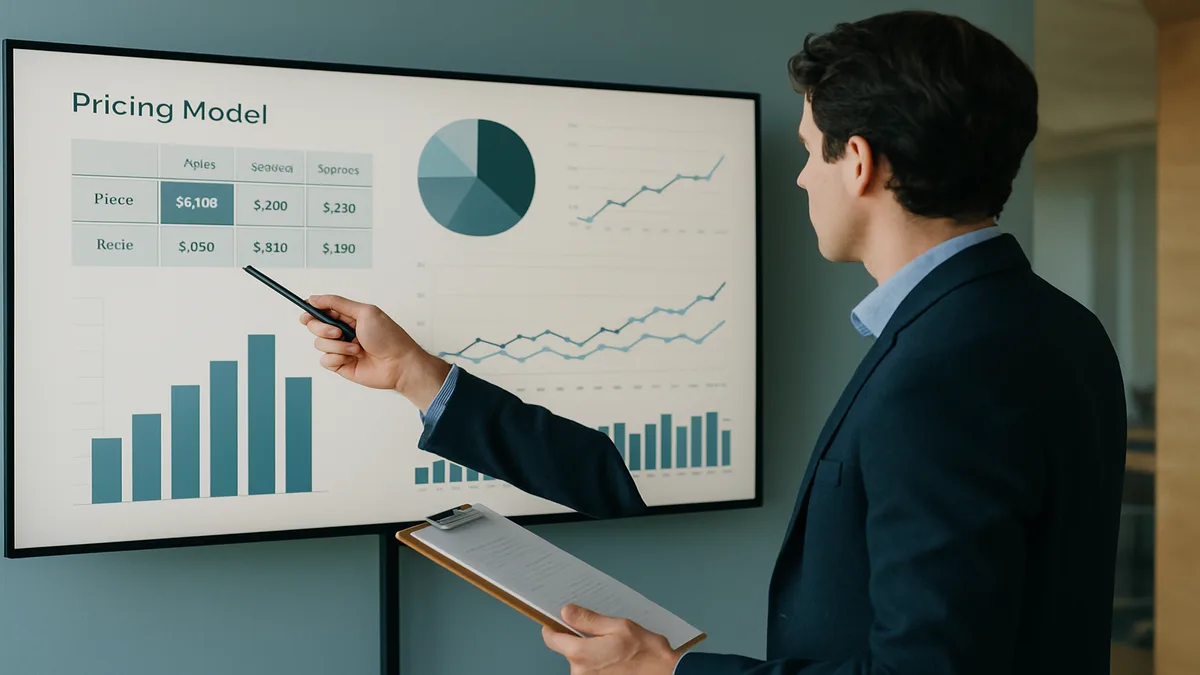
The Five Pricing Models for Hotel Suppliers
1. Cost-Plus Pricing: The Safe Default
Cost-plus pricing is exactly what it sounds like: you calculate your total cost per unit (materials, labor, overhead, shipping, duties) and add a fixed markup. Most hotel suppliers start here because it is simple, transparent, and guarantees a minimum margin on every order.
How it works in practice:
- Manufacturing cost per towel set: $8.40
- Shipping and duties: $1.60
- Total landed cost: $10.00
- Markup at 35%: $3.50
- Selling price: $13.50
When it works:
- Commodity products where specifications are standardized (basic white bath towels, standard pillow cases)
- GPO catalog submissions where price transparency is required
- Initial market entry when you need quick wins to build a track record
When it fails:
- Against manufacturers selling direct from lower-cost countries
- When your product has features competitors do not
- In renovation and new-build projects where total cost of ownership matters more than unit price
Cost-plus is the training wheels of pricing. It gets you started. It should not be where you stay.
2. Value-Based Pricing: Charging for Outcomes
Value-based pricing sets price according to the economic value your product delivers to the hotel, not what it costs you to make. This is the single most powerful pricing shift a supplier can make, and it requires understanding hotel operations well enough to quantify your impact.
Examples of value-based pricing in hotel supply:
| Product | Cost-Plus Price | Value-Based Price | Justification |
|---|---|---|---|
| Commercial-grade mattress | $320 | $480 | Lasts 10 years vs. 6 years; fewer guest complaints; lower replacement frequency |
| Bulk dispenser system | $45/unit | $75/unit | Eliminates $2,200/year in mini-bottle waste per room block; sustainability compliance |
| Stain-resistant banquet linen | $28/set | $42/set | 40% longer lifecycle; 60% fewer replacements; reduced laundry chemical use |
| Smart thermostat PTAC unit | $890 | $1,350 | Saves $340/room/year in energy; IoT reduces hotel energy use by 20-45% |
The key is that you must be able to articulate the value numerically. Hotel procurement directors live in spreadsheets. “Our towels are softer” is not a value proposition. “Our towels maintain GSM weight through 300 wash cycles versus 180, reducing annual replacement spend by $4,200 across 200 rooms” is.
How to build a value case:
- Calculate the hotel’s total cost of ownership (purchase + maintenance + replacement + disposal)
- Benchmark against the incumbent product they are currently using
- Quantify the gap in dollars per room per year
- Price your product at 40-60% of the value gap (the hotel keeps the rest as savings)
This leaves both sides better off — and it is extremely difficult for a low-cost competitor to displace you, because the conversation is no longer about unit price.
3. Tiered Pricing: Good / Better / Best
Tiered pricing gives hotel buyers three options at different price points, each with a clearly defined feature set. This is the dominant model in hospitality FF&E because hotels operate across segments (economy, midscale, upscale, luxury) and need products that match their brand tier.
Example: Bathroom Amenity Program
| Tier | Product | Price/Room/Month | Features |
|---|---|---|---|
| Essential | Standard bulk dispensers | $4.50 | Basic formulations, wall-mounted, refillable |
| Professional | Branded refillable dispensers | $8.00 | Premium formulations, custom branding, anti-theft mount |
| Signature | Curated artisanal collection | $14.00 | Locally sourced ingredients, designer packaging, seasonal rotation, sustainability certification |
Why tiered pricing works:
- It anchors the buyer’s perception. The “Signature” tier makes the “Professional” tier look reasonable, even if Professional was your target all along.
- It segments your customer base without requiring separate sales processes. A Hilton Garden Inn and a Waldorf Astoria can both buy from you.
- It creates natural upsell paths. A hotel that starts at Essential during renovation often moves to Professional within 18 months as occupancy stabilizes.
The biggest mistake suppliers make with tiered pricing is creating tiers that differ only in quantity or material grade. Effective tiers differ in service level: dedicated account manager, custom branding, sustainability reporting, faster lead times, consignment inventory.
4. Volume Discounts and Contract Pricing
Volume discounts are standard in hospitality procurement, but most suppliers structure them poorly — offering linear discounts that erode margin without locking in commitment.
A smarter volume discount structure:
| Annual Commitment | Discount | Lock-In |
|---|---|---|
| Under $50,000 | List price | None |
| $50,000 - $150,000 | 8% | 12-month agreement |
| $150,000 - $500,000 | 14% | 24-month agreement with quarterly minimums |
| $500,000+ | 18-22% | 36-month agreement with exclusivity clause |
The critical elements:
- Discounts are tied to commitments, not promises. A management company saying “we’ll probably order $300K this year” gets list price until they sign a contract.
- Quarterly minimums protect against backloading. Without them, a buyer signs a $500K annual deal, orders $50K in Q1-Q3, then demands the deep discount rate on a massive Q4 order.
- Exclusivity at the top tier is the real prize. An 18% discount sounds aggressive, but if you are the sole approved supplier of bed linens for a 200-property management company, you have locked out every competitor for three years.
Contract pricing vs. spot pricing:
Contract pricing offers fixed rates over a defined period, protecting both parties from volatility. Spot pricing is order-by-order, typically at higher unit rates. The strategic play is to offer contract pricing as the default and position spot pricing as a premium convenience — reversing how most suppliers think about it.
Hotels that refuse contracts pay 10-15% more per order. Hotels that commit get stability and savings. This incentivizes the behavior you want: long-term relationships with predictable revenue.
Stop chasing hotels manually. InnLead.ai’s 12 AI agents scan renovation signals, identify procurement contacts, and book meetings with hotel buyers — automatically. Get Early Access
5. Total Cost of Ownership (TCO) Framing
TCO framing is not a pricing model per se — it is a lens through which you present any price. And it is the single most effective tool for defeating low-cost competition, particularly from manufacturers in China and Southeast Asia who compete almost exclusively on unit price.
TCO calculation for hotel furniture (per guest room):
| Cost Element | Low-Price Import | Premium Domestic |
|---|---|---|
| Unit purchase price | $2,800 | $4,200 |
| Shipping (ocean freight + last mile) | $620 | $180 |
| Duties and tariffs | $340 | $0 |
| Lead time cost (30 weeks vs. 10 weeks) | $800* | $0 |
| Warranty claims (Year 1-3) | $450 | $120 |
| Replacement at Year 5 | $2,800 | $0 (rated for 8+ years) |
| 5-Year TCO | $7,810 | $4,500 |
Lead time cost estimated from delayed room revenue during renovation projects.
The low-price import looks 33% cheaper on the purchase order. It costs 74% more over five years. This is the argument that wins deals — but only if you quantify it before the procurement director sees only the unit price column.
Timber prices alone increased 35% between 2022 and 2024, and hospitality vendors reported price hikes of 90-300% on various products during the post-pandemic supply chain disruption. Hotels that chased the lowest unit price during those years ended up paying more in expediting, replacements, and project delays.
Defeating Low-Cost Competition Without a Price War
The biggest pricing threat most hotel suppliers face is not a domestic competitor with a better product. It is a factory in Foshan or Dongguan quoting 40% below your best price. Here is how to compete without destroying your margins.
Compete on Risk, Not Price
Hotel renovation projects operate on tight timelines. A PIP deadline missed by 60 days can trigger brand penalties. When you are competing against a 14-week ocean freight timeline, your pitch is not about product quality — it is about project risk.
Frame the conversation around:
- Lead time certainty: 4-6 weeks domestic vs. 14-22 weeks import (with port delay risk)
- Sample and revision speed: 5 business days vs. 4-6 weeks
- Warranty enforcement: U.S.-based warranty resolution vs. international arbitration
- Compliance documentation: Immediate access to fire ratings, ADA compliance certificates, sustainability certifications
Bundle Services Into the Price
A product is a commodity. A product plus installation plus disposal plus ongoing support is a solution. The more services you bundle into your price, the harder it becomes for a buyer to compare you apples-to-apples with a factory quote.
High-value bundles for hotel suppliers:
- Product + Installation + Disposal of old inventory — eliminates three separate vendor relationships
- Product + Warehousing + Just-in-Time Delivery — reduces the hotel’s storage burden during phased renovations
- Product + Design Consultation + Mockup Room — positions you as a partner, not a vendor
- Product + Sustainability Documentation + ESG Reporting Support — increasingly valuable as chains pursue net-zero targets (Marriott 2050, Hilton 2030 intensity reduction goals)
Use Specification as a Moat
If you can get your product written into a brand’s property improvement plan specifications, price becomes secondary. The PIP says “ABC-brand blackout curtain model 4200 or equivalent,” and suddenly every competitor has to prove equivalency — which is a far harder sale than being the named specification.
How to get specified:
- Build relationships with brand design teams, not just procurement — our guide on finding hotel procurement contacts and decision makers maps the full buying hierarchy
- Provide detailed CAD files, material samples, and fire-test certifications proactively
- Offer free mockup room installations at brand prototype properties
- Attend HD Expo (600+ exhibitors, May annually in Las Vegas) and BDNY (Javits Center, November) where brand designers source products
Pricing Model Comparison: Which Strategy Fits Your Business
| Pricing Model | Best For | Margin Potential | Competitive Moat | Complexity |
|---|---|---|---|---|
| Cost-Plus | Commodity products, GPO catalog sales | Low (15-25%) | None — easily undercut | Low |
| Value-Based | Differentiated products, renovation projects | High (35-55%) | Strong — requires buyer education | High |
| Tiered (Good/Better/Best) | Suppliers serving multiple hotel segments | Medium-High (25-45%) | Medium — tiers create switching cost | Medium |
| Volume/Contract | Management companies, chain-level deals | Medium (20-35%) | Strong — exclusivity locks out competitors | Medium |
| TCO Framing | Competing against low-cost imports | High (30-50%) | Very Strong — shifts conversation from price to cost | High |
Most successful hotel suppliers use a combination. They might use cost-plus for GPO catalog items (where price is the only differentiator), value-based pricing for direct sales to independent hotels, and tiered contract pricing for management company portfolios.
Common Pricing Mistakes Hotel Suppliers Make
Quoting before qualifying. If a buyer asks for pricing in the first email, do not send a price sheet. Ask about their property count, brand standards, renovation timeline, current supplier, and pain points. A price without context is just a number for them to shop against. Our email marketing templates for hotel suppliers include sequences designed to qualify buyer needs before quoting.
Discounting without getting something in return. Every discount should be tied to a concession: longer contract term, higher volume commitment, faster payment terms, testimonial rights, or referral agreement. Free discounts train buyers to always ask for more.
Ignoring payment terms as a pricing lever. Net-60 at $10.00 per unit is not the same as Net-15 at $10.00 per unit. If a hotel chain wants extended payment terms, price it in. A 2% discount for Net-15 payment often costs less than 60 days of float on a $200K order.
Pricing identically across channels. Your price to a GPO (where they take 3-7% and you get volume) should be structurally different from your price to an independent hotel (where you keep the full margin but do all the sales work). Build channel-specific pricing from the start.
Failing to raise prices annually. Renovation costs increased 6.25% from 2022 to 2023 alone. PIP costs are up 30%+ versus pre-COVID levels. If your prices are not keeping pace with input costs, your margins are shrinking every quarter. Build annual escalation clauses (2-4%) into every contract.
Building Your Pricing Architecture
A pricing architecture is not a single spreadsheet. It is a system that maps pricing models to customer segments, channels, and product categories. Here is a framework:
- Segment your customer base. Chain hotels, management companies, independents, GPOs, designers/specifiers. Each gets a pricing approach.
- Classify your products. Which are commodities (compete on price/volume)? Which are differentiated (compete on value)? Which are custom (compete on capability)?
- Set floor prices. Below these, you walk away. Calculate based on fully loaded cost plus minimum acceptable margin.
- Build discount matrices. Define exactly what volume, commitment, or behavior earns each discount tier. No ad hoc discounting.
- Create approval workflows. Any discount above 15% requires sales director approval. Above 25% requires VP approval. This prevents field reps from giving away margin to close a deal.
- Review quarterly. Input costs change. Competitive dynamics shift. Your pricing should be a living system, not a document you update once a year.
The hotel supply market is growing. The construction pipeline hit a record 15,820 projects globally as of Q4 2024, and the renovation backlog remains massive. Suppliers who price strategically will capture disproportionate share of that growth. Suppliers who race to the bottom will find that the bottom is very, very far down. To ensure your value message reaches the right audience, combine a strong pricing architecture with a digital brand-building playbook that positions you as a premium partner.
Price for value. Bundle for differentiation. Quantify everything. And never, ever send a price sheet before you understand what the buyer actually needs. Need help communicating your value online? Explore InnLead.ai’s services for hotel suppliers.
Use these related guides to keep moving through the same procurement, sales, or market research thread.
Skip the Manual Work
InnLead.ai's 12 AI agents find hotels buying your products, identify procurement contacts, and book meetings -- automatically.
Get Early Access